
Filters
Category
- Pygmy Drosera63
- Stickers & Fridge magnets45
- Mexican Pinguicula44
- CP seeds40
- Terrestrial Utricularia34
- Earrings25
- Sarracenia - species24
- Sarracenia - hybrids22
- Subtropical Drosera22
- Slovenian wildflowers17
- Dionaea (Venus Flytrap)14
- Substrate10
- Dreamcatchers9
- Keychains8
- Bracelets7
- Epiphytic Utricularia7
- Temperate Drosera6
- Medicinal and Herb plants5
- Exotic plants4
- Other Pinguicula4
- Pots & stuff4
- Edible plants3
- Cephalotus (Albany Pitcher Plant)1
- Choice shrubs & perennials1
- Darlingtonia (Cobra Lily)1
- Predator Packs1
- Stylidium (Trigger plant)1
- Wire wrapping1
Size
- Medium118
- Large117
- Small117
- 5 cm pot15
- 2 cm x 2 cm plug14
- 2 cm x 2 cm portion9
- 5 cm round pot8
- XL3
- 1 gabbietta (1=11
- 1 gabbietta (1=1,25eur)1
- 1 plant1
- 1 pot (1=01
- 1 pot (1=0,75eur)1
- 1 pot (1=11
- 1 pot (1=1,65 eur)1
- 10 gabbietta (1=1.10eur)1
- 10 pots (1=01
- 10 pots (1=0,60eur)1
- 10 pots (1=1.50 eur)1
- 10 seeds1
- 100 seeds1
- 2 plants1
- 25eur)1
- 3 plants1
- 5 gabbietta (1=1.20eur)1
- 5 pots (1=01
- 5 pots (1=0,70eur)1
- 5 pots (1=11
- 5 pots (1=1,60 eur)1
- 50 seeds1
- 60 eur)1
- 60eur)1
- 65 eur)1
- 70eur)1
- 75eur)1
- Extra Large1
- Hanging basket1
- Medium - 1 medium size plant1
- Pack of 3 rooted cuttings1
- Small - 1 pack of 3 plugs1
What you see is what you get
Availability
Offers
All Products
CP seeds
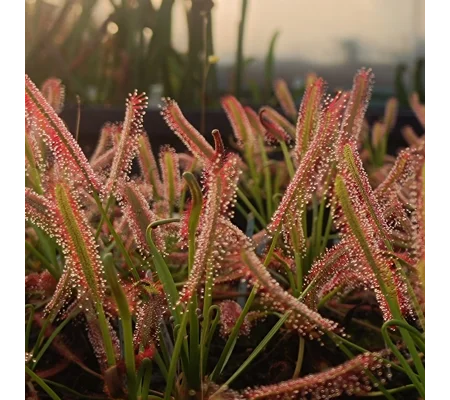
Drosera capensis MIX, 50 seedsDrosera capensis is a sub-tropical sundew endemic to the southwestern Cape where it can be found in marshes, along streams, permanent seeps and damp areas of fynbos. A very easy sundew to grow, suitable for begginers. The Cape sundew is fast growing and single plants can live for many years with young suckers forming at the base. Pink flowers, red sticky hairs. It is a free-flowering and fascinating house plant. Self-fertile, will self-seed. One adult plant per portion, very often with flowers, usually with small seedlings around it. This sundew is a prooven mosquito and fruit fly catcher. We offer fresh seeds, a new suply is collected every Autumn. Seeds are open pollinated, so there will be typical, alba, all red, hairy and giant seedlings sprouting - and, who knows, maybe something completely new!
Subtropical Drosera
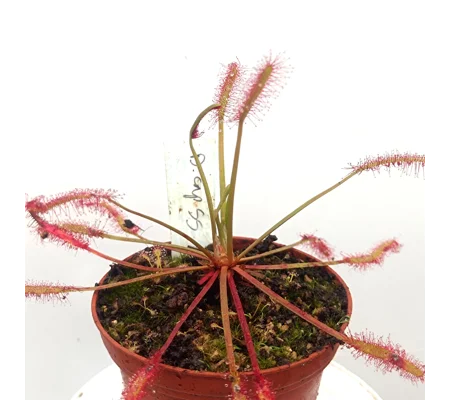
Drosera capensis Spider SeedDrosera capensis Spider Seed is my own selection. It has particularly long and thin petioles. Young leaves are orangey in summer and bright green in winter. Older leaves are completely bright red in summer and red in the top half with the lamina in winter. Drosera capensis is a sub-tropical sundew endemic to the southwestern Cape where it can be found in marshes, along streams, permanent seeps and damp areas of fynbos. A very easy sundew to grow, suitable for begginers. The Cape sundew is fast growing and single plants can live for many years with young suckers forming at the base. Pink flowers, red sticky hairs. It is a free-flowering and fascinating house plant. Self-fertile, will self-seed. You can find cultivation tips and more on our YouTube channel https://www.youtube.com/@RanchOfPlants
Subtropical Drosera
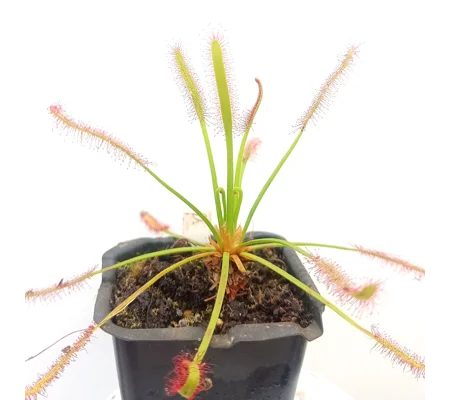
Drosera capensis TYPICALDrosera capensis is a sub-tropical sundew endemic to the southwestern Cape where it can be found in marshes, along streams, permanent seeps and damp areas of fynbos. A very easy sundew to grow, suitable for begginers. The Cape sundew is fast growing and single plants can live for many years with young suckers forming at the base. It is a free-flowering and fascinating house plant.Self-fertile, will self-seed. One adult plant per portion, very often with flowers.You can find cultivation tips and more on our YouTube channel https://www.youtube.com/@RanchOfPlants
CP seeds
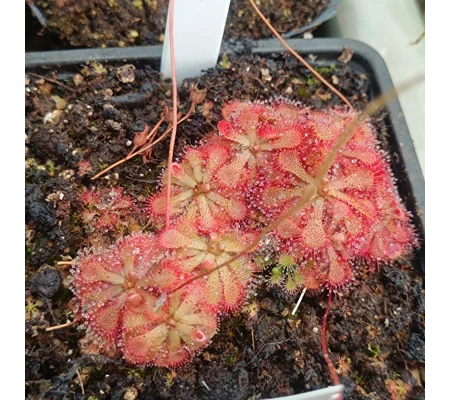
Drosera cf. cayennensis, 30 seedsDrosera cayennensis is, to my knowledge at least, super rare in cultivation. I guess I could sell these the seeds at an exorbitant rate. I won't do that. Firstly, the detemination of this taxon is not 100%. Usually the rule in the grower community is to label a plant with a shakey or missing determination a NOID or sp. 1 or something similar. My background is in systematic botany where uncertain determiantions are prefixed with the abbreviation "cf.", which stands for the Latin word confer, meaning "compare". Cf indicates that the determination is a best guess and whoever it may concern should compare the cf. taxon to the referenced species. Secondly, I prefer if prices are set according to difficulty of propagation or difficulty of obtaining a crop of seeds. This plant seeds ok and is easy to grow, and it isn't some new variety I've been working on and selecting for years. And if you decide to grow it we're on a good way to making this Drosera cf. cayennensis more readily available.
Pygmy Drosera
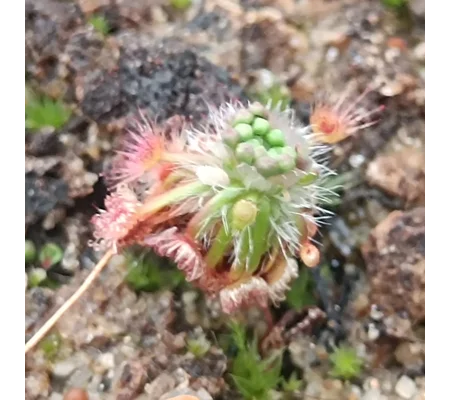
Drosera closterostigma Mogumber, 10+ gemmaeThe epithet closterostigma is derived from the Greek closteros (spindle-shaped), and stigma (stigma), in reference to the shape of the stigma of this species. Drosera closterostigma is known from Western Australia, with records from Gingin to Cataby, and eastwards towards Mogumber It grows in deep white sand which often appears grey in colour due to the presence of humus. Often situated in winter-wet depressions or swampland heath in association with numerous herbaceous species, low shrubs and paperbark trees (Melaleuca sp.). You can find cultivation tips and more on our YouTube channel https://www.youtube.com/@RanchOfPlants
CP seeds
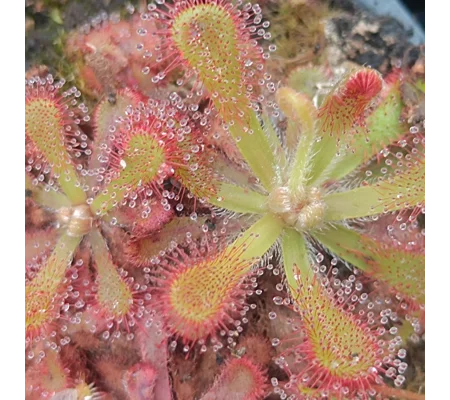
Drosera coccicaulis, 30 seedsDiscover Drosera coccicaulis, 30 seeds of this unique CP seeds variety! A rosette-forming plant from South Africa, it's a must-have for collectors!
CP seeds
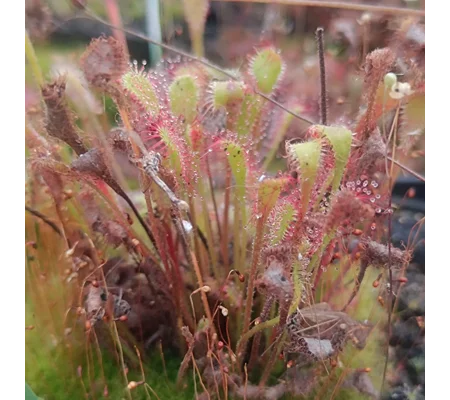
Drosera collinsiae Vryheid, SA, 30 seedsThe native range of Drosera collinsiae is the subtropical zone of South Africa.It is found in Cape Provinces, Free State, KwaZulu-Natal, Lesotho and Northern Provinces, and is another of many Cape biome endemics.Drosera collinsiae Vryheid was originally collected near Vryheid is a historic coal-mining and cattle-ranching town located in northern KwaZulu-Natal, South Africa. The name Vryheid means "freedom" in Afrikaans and is misspelled in some catalogues as Vryaheid.
Pygmy Drosera
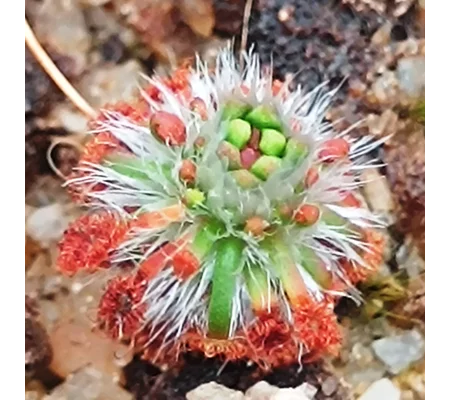
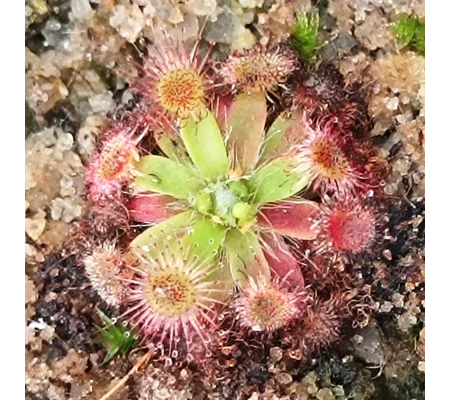
Drosera coomallo, 10+ gemmaeThe epithet coomallo appears to be derived from a Noongar indigenous Australian word. Its meaning is unknown. Since colonisation, Coomallo has been the name given to Coomallo Creek, named by a surveyor in 1880. Hence, Coomallo Pool, Coomallo phone exchange and Coomallo Nature Reserve, on the edge of which this species was rediscovered. Drosera coomallo is known from Western Australia, with records around Badgingarra, Cataby and Coomallo. This species grows in laterite pebbles with a little silica sand over laterite sheet rock on the slopes of lateritic hills. You can find cultivation tips and more on our YouTube channel https://www.youtube.com/@RanchOfPlants
Pygmy Drosera
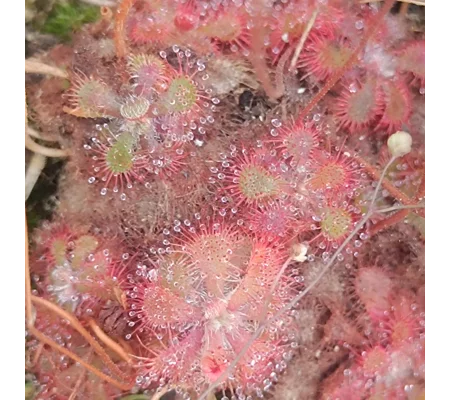
Drosera depauperata, 10+ gemmaeThe epithet depauperata is from the Latin depauperatus (depauperate), a reference to its much-reduced flower size as compared to the morphologically similar flower of Drosera pulchella. This species is thought to have originated as a fertile natural hybrid between Drosera australis and Drosera pulchella; the reduced flower size of Drosera depauperata may be due to the influence of putative parent Drosera australis, with its rather small flower. Drosera depauperata is known from Western Australia, with records only from the type location on the margins of Lake Pleasant View, near Manypeaks, where it is quite common. It grows on the margins of the lake and in wet depressions in sandy soils under paperbarks (Melaleuca sp.). You can find cultivation tips and more on our YouTube channel https://www.youtube.com/@RanchOfPlants
CP seeds
Drosera dielsiana Zimbabwe, 30 seedsDrosera dielsiana is a compact rosetted sundew native to South Africa (KwaZulu-Natal, the Free State, the Northern Provinces), Eswatini (Swaziland), Mozambique, Malawi, and Zimbabwe. It was described as a new species by Arthur Wallis Exell and Jack Rodney Laundon in 1956. The diploid chromosome number is 2n=40. It was named in honor of Ludwig Diels, the author of the 1906 monograph on the Droseraceae.
Pygmy Drosera
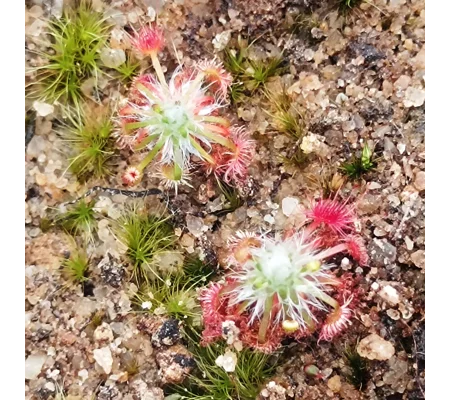
Drosera echinoblastus, 10+ gemmaeThe epithet echinoblastus is derived from the Greek echinos (spine) and blastos (shoot), in reference to the bristly stipule bud of this species. Drosera echinoblastus is widespread in the Hill River region, Coomallo and Mount Lesueur in Western Australia, but has a range that runs 100 km to the north and 200 km to the south of this area. It grows in deep white sandy soils or beige clayey-sand soils between and under low shrubs on heathland. Drosera echinoblastus favours sites beside winter-wet streams, streamlets, depressions and watershed areas. You can find cultivation tips and more on our YouTube channel https://www.youtube.com/@RanchOfPlants
Pygmy Drosera
Drosera eneabba A, 10+ gemmaeThe epithet eneabba is an indigenous Australian name for the nearby springs, ena meaning water, and abba meaning small, thus small springs . This species was first discovered near the town of Eneabba. Drosera eneabba is known from Western Australia, principally Eneabba, Badgingarra, Coomallo and Mount Lesueur. It grows in white silica sand soils in low, open heath. You can find cultivation tips and more on our YouTube channel https://www.youtube.com/@RanchOfPlants