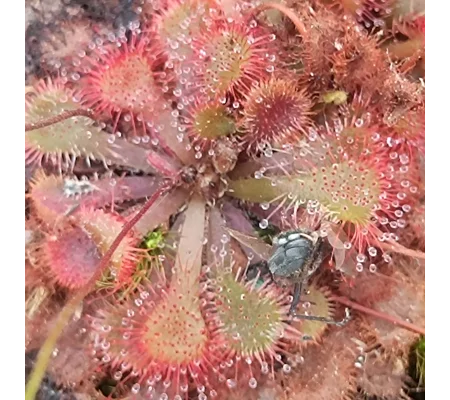
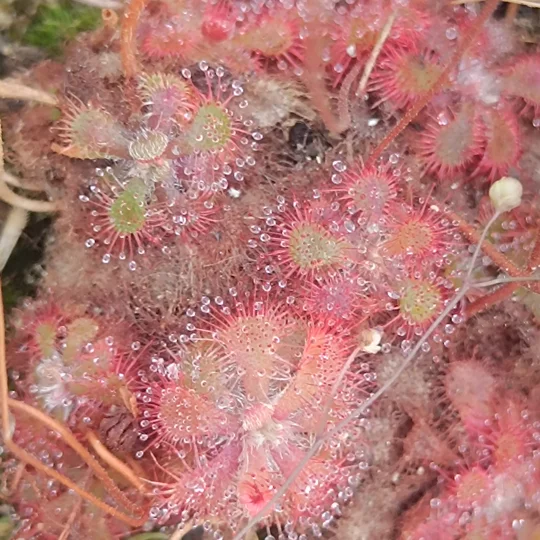
Drosera dielsiana Zimbabwe, 30 seeds
Drosera dielsiana is a compact rosetted sundew native to South Africa (KwaZulu-Natal, the Free State, the Northern Provinces), Eswatini (Swaziland), Mozambique, Malawi, and Zimbabwe. It was described as a new species by Arthur Wallis Exell and Jack Rodney Laundon in 1956. The diploid chromosome number is 2n=40. It was named in honor of Ludwig Diels, the author of the 1906 monograph on the Droseraceae.
Drosera dielsiana is a compact rosetted sundew native to South Africa (KwaZulu-Natal, the Free State, the Northern Provinces), Eswatini (Swaziland), Mozambique, Malawi, and Zimbabwe. It was described as a new species by Arthur Wallis Exell and Jack Rodney Laundon in 1956. The diploid chromosome number is 2n=40. It was named in honor of Ludwig Diels, the author of the 1906 monograph on the Droseraceae.
A lot of 'dielsiana' plants in cultivation are actually Drosera natalensis. The two species are indeed very similar. The sources I've seen talk about diagnostic features on seeds, petioles and flowers.
Drosera dielsiana is highly misidentified species, often confused with its very close relative D. natalensis. Apparently most 'dielsiana' in cultivation are actually Drosera natalensis. The so-called Drosera sp. “Pretty Rosette” may represent one of very few true Drosera dielsiana in cultivation.
Drosera dielsiana is tentatively recorded from much of the southeastern mountain-savannah landscape of Africa: Malawi, Mozambique, Zimbabwe, Lesotho, Eswatini, Mpumalanga, Freestate and KwaZulu-Natal, South Africa.
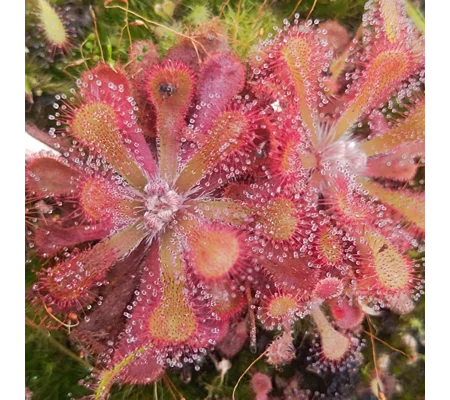
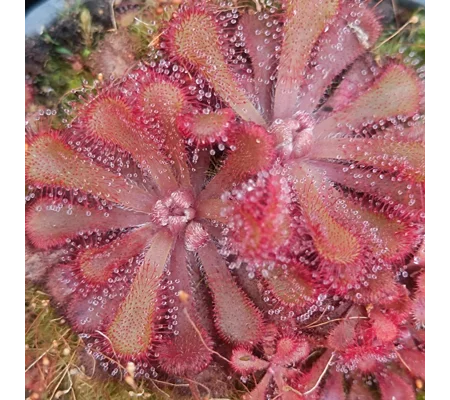
Plants tend to grow above 900 meters in elevation, in wet peaty soils near depressions, seeps, or waterways often in thin layers over rock outcrops. This species grows to rarely more than 4 cm in diameter (often less), with roughly flat rosettes of broad oblong leaves bearing thick though often very short, pubescent petioles and slightly to notably broader obovate or triangular to oblong lamina. Flowers pink, red or purple, often do not open.
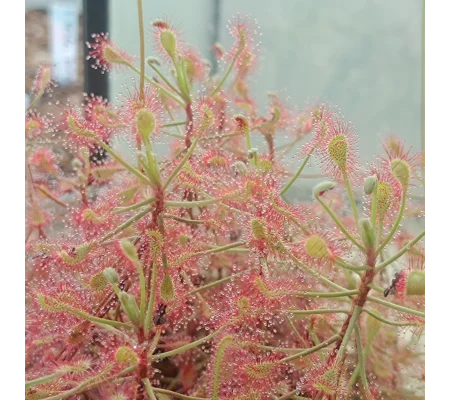
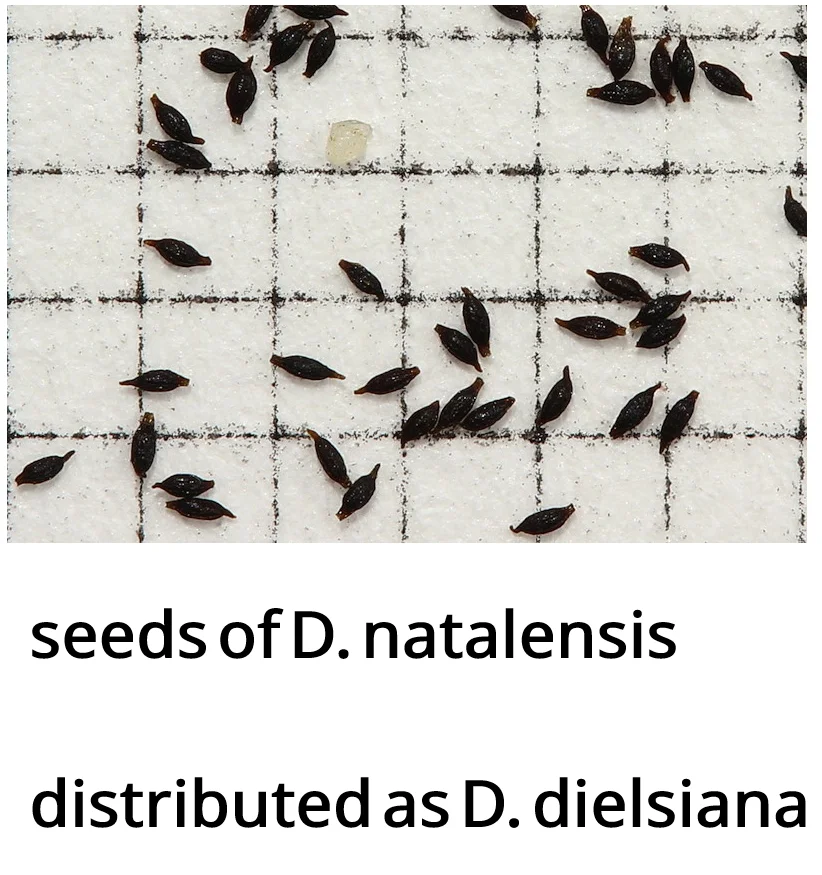
Color is bright green to solid red, with crimson tentacles. Inflorescences may reach more than 30 cm in height and grow ascending, covered in small glandular trichomes and bearing up to 15 or more blooms. Flowers are approximately 1.5 cm at most, with narrow ovoid petals. Flowers pink, red or purple, often do not open.To reliably distinguish this species from D. natalensis, seed and style morphology is necessary: this taxon possesses simple, relatively undivided styles and oblong-rounded seeds, while D. natalensis possesses more heavily divided styles and fusiform (possessing narrow appendages at the tips) seeds.
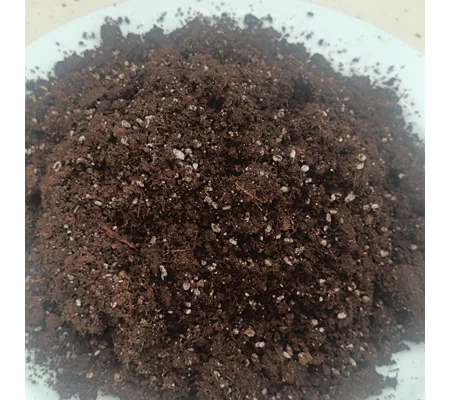
Another supposedly good way to distinguish between Drosera natalensis and Drosera dielsiana are seeds. According to Flora Zambesiaca 4. 1978. in Drosera natalensis seeds are 0·4–0·6 x 0·1–0·2 mm., black, ellipsoid-fusiform, testa more or less foveolate. And seeds in Drosera dielsiana are: 0·3–0·6 x 0·2 mm., black, ovoid; testa usually foveolate. Please refer to pictures – at some point I will make better pics, side by side on milimeter grid paper.
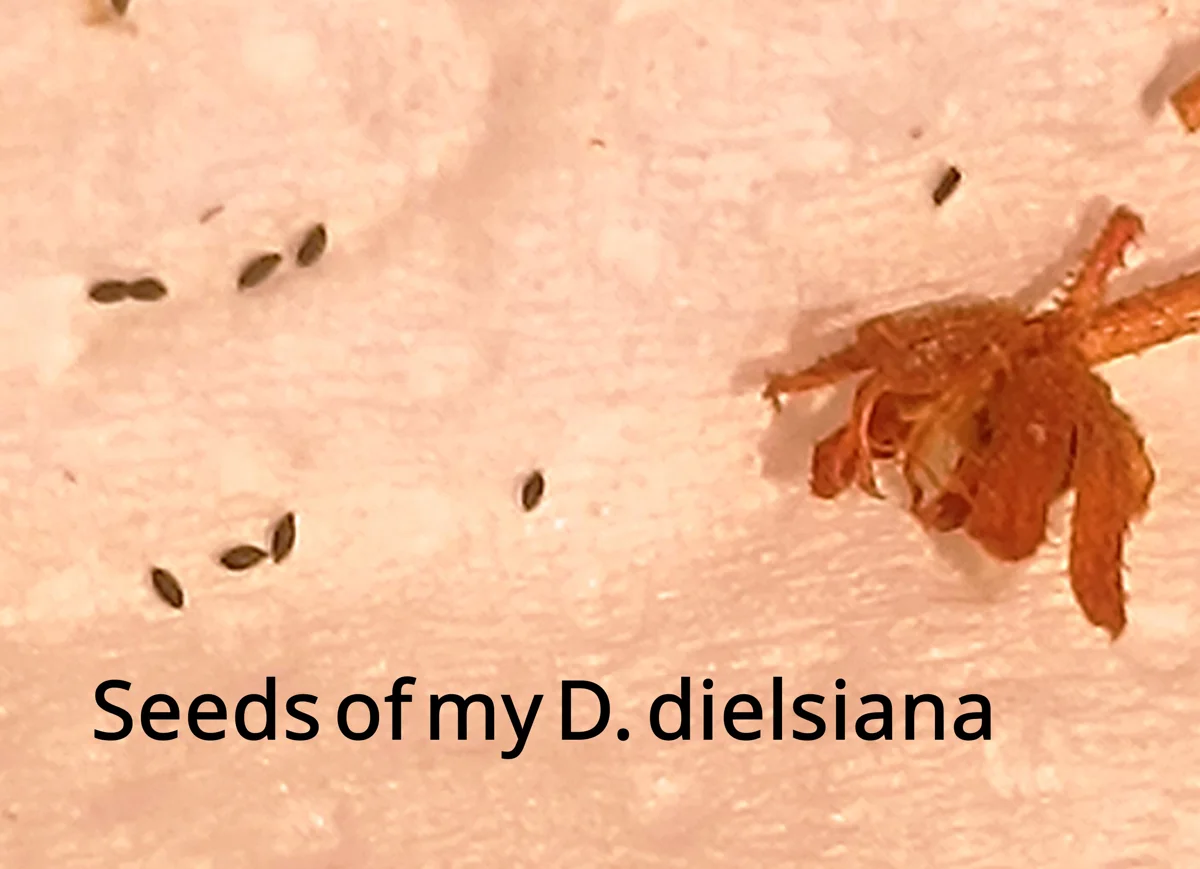
The plant on offer here indeed appears quite different from Drosera natalensis that I also grow. So for now we'll stay with determination of Drosera dielsiana and revise it if or when the opportunity arizes.
| Title | Drosera dielsiana Zimbabwe, 30 seeds |
|---|---|
| Category | CP seeds |
| SKU | DroDie30s |
| Condition | new |