
Filters
Category
- Pygmy Drosera63
- Stickers & Fridge magnets45
- Mexican Pinguicula44
- CP seeds40
- Terrestrial Utricularia34
- Earrings25
- Sarracenia - species24
- Sarracenia - hybrids22
- Subtropical Drosera22
- Slovenian wildflowers17
- Dionaea (Venus Flytrap)14
- Substrate10
- Dreamcatchers9
- Keychains8
- Bracelets7
- Epiphytic Utricularia7
- Temperate Drosera6
- Medicinal and Herb plants5
- Exotic plants4
- Other Pinguicula4
- Pots & stuff4
- Edible plants3
- Cephalotus (Albany Pitcher Plant)1
- Choice shrubs & perennials1
- Darlingtonia (Cobra Lily)1
- Predator Packs1
- Stylidium (Trigger plant)1
- Wire wrapping1
Size
- Medium118
- Large117
- Small117
- 5 cm pot15
- 2 cm x 2 cm plug14
- 2 cm x 2 cm portion9
- 5 cm round pot8
- XL3
- 1 gabbietta (1=11
- 1 gabbietta (1=1,25eur)1
- 1 plant1
- 1 pot (1=01
- 1 pot (1=0,75eur)1
- 1 pot (1=11
- 1 pot (1=1,65 eur)1
- 10 gabbietta (1=1.10eur)1
- 10 pots (1=01
- 10 pots (1=0,60eur)1
- 10 pots (1=1.50 eur)1
- 10 seeds1
- 100 seeds1
- 2 plants1
- 25eur)1
- 3 plants1
- 5 gabbietta (1=1.20eur)1
- 5 pots (1=01
- 5 pots (1=0,70eur)1
- 5 pots (1=11
- 5 pots (1=1,60 eur)1
- 50 seeds1
- 60 eur)1
- 60eur)1
- 65 eur)1
- 70eur)1
- 75eur)1
- Extra Large1
- Hanging basket1
- Medium - 1 medium size plant1
- Pack of 3 rooted cuttings1
- Small - 1 pack of 3 plugs1
What you see is what you get
Availability
Offers
All Products
Sarracenia - species
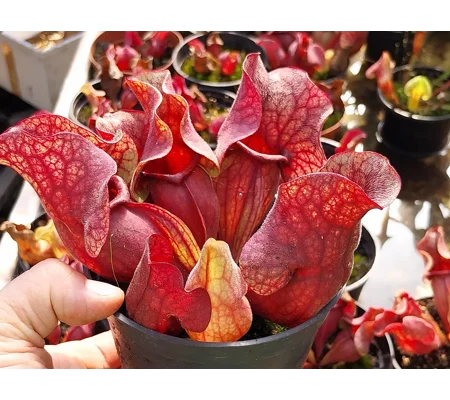
Sarracenia purpurea subsp. venosaSarracenia purpurea subsp. venosa is a winterhardy plant. It can survive winters below -20C and is therefore best grown as an outdoor plant. But it won't mind being grown as a house plant. Try to give it a cool winter rest, if possible. Sarracenia purpurea is distributed on the Eastern seaboard, the Great Lakes region, Canada except Nunavut and Yukon, Washington state, and Alaska. That makes it the most common and broadly distributed pitcher plant, as well as the only member of the genus that inhabits cold temperate climates. It is endangered or vulnerable over much of the southern part of its range. Many venosa populations are extinct in the wild and only exist location plants in collections.You can find cultivation tips on our YouTube channel https://www.youtube.com/@RanchOfPlants
Sarracenia - species
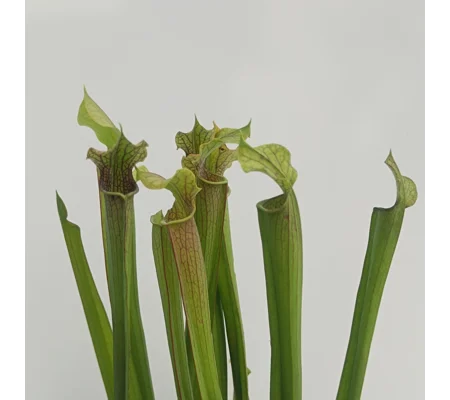
Sarracenia rubra subsp. gulfensisSarracenia rubra subsp. gulfensis is a fast grower with a beautiful red flower and exquistie red veining inside the pitcher mouths. The leaves are slender, upright, not too tall (around 50 cm to 60 cm), don't fall to the sides, and last well into the winter. If you're looking for a pitcher plant for a gift that needs to be 'carnivorous and leafy', this is the one I'd recommend. I've grown this plant since the early 2000s, so there's a large stock and because of this the plant gets overlooked - don't we all percieve as valuable that which is rare? This overlooking is really unjust, because the plant genuinly is beautiful. Of all the rubras, this one has the biggest red flower, and it smells as sweet as a rubra flower should. The fact that it grows fast is more than likely the result of its success at catching flies, wasps and othe flying insects.You receive an adult plant.You can find cultivation tips on our YouTube channel https://www.youtube.com/@RanchOfPlants
Sarracenia - species
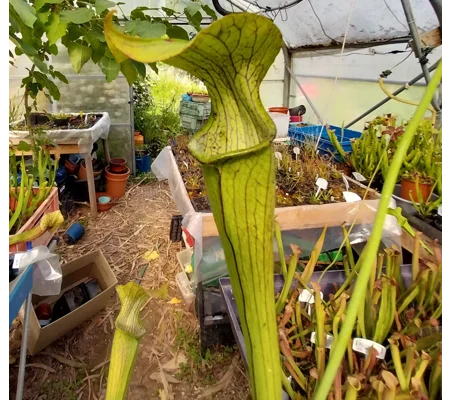
Sarracenia rubra subsp. jonesiiSarracenia rubra subsp. jonesii looks very much like a large version of Sarracenia rubra subsp. rubra. The flowers smell sweet and have a hint of the raspberry smell similar to that of S. rubra subsp. rubra flowers. As is typical for the subspecies the spring leaves are kind of floppy, with a large midrib. It is speculated that this is to maximise the surface area for photosynthesis in spring, carnivory becoming really important only in summer. Sarracenia rubra subsp. jonesii is endemic to 10 mountain bogs on the border between North (Buncombe, Henderson, Transylvania Co) and South (Greenville, Pickens Co) Carolina. It's a bog plant, but sometimes occurs at sites called "cataract bogs." These are places where the surface water sheets out over huge, sloping granite slabs. The plants kling to edges and any holdfast on these slabs. It is extremely endangered in the wild and listed as such on the Appendix I of CITES.
Sarracenia - species
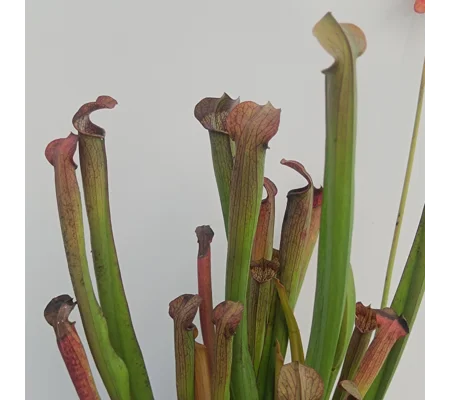
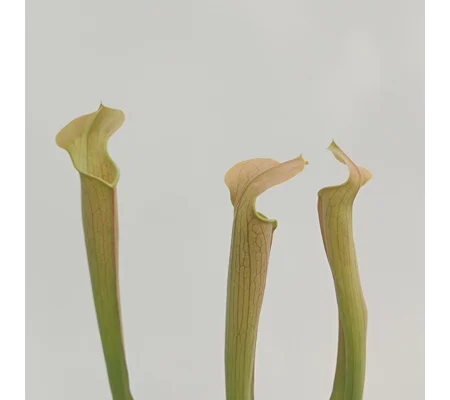
Sarracenia rubra subsp. rubraSarracenia rubra subsp. rubra is the smallest rubra subspecies. Rather compact dark green plant with strong red hue on the tops of its pitchers and pinstriped veining. Fast grower, will form a nice big clump faster than most other sarracenias. Pitchers are slender but compact, only 26-45 cm tall, and last well into the winter. I have read the comment that the pitchers look like standing meerkats - and yes, I can definately see this, can you? In all, a very cute plant. It has a distinct flower: small, with a distinct sweet raspberry smell and dark red petals that have a notch on their distal edges. Sarracenia rubra subsp. rubra inhabits coastal plains of North Carolina, South Carolina, and southeastern Georgia.You receive an adult plant.You can find cultivation tips on our YouTube channel https://www.youtube.com/@RanchOfPlants
Sarracenia - species
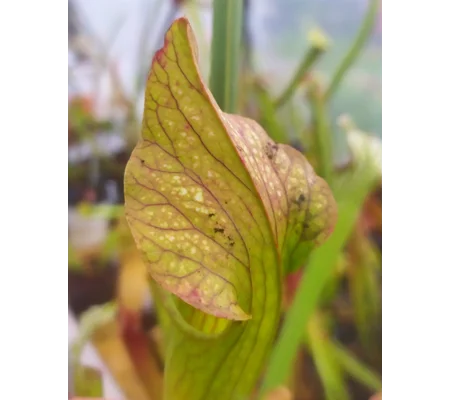
Sarracenia rubra subsp. wherryiSarracenia rubra subsp. wherryi is named after the famous botanist E.T. Wherry. It is commonly found with Sarracenia leucophylla, although hybrids are rare. In essence, this plant looks like a short version (8-45 cm, average 18 cm tall) of the taller Sarracenia alabamensis subsp. alabamensis (18-71 cm, average 40 cm tall). This clone is very pubescent. As is typical for the subspecies the spring leaves are kind of floppy, with a large midrib. It is speculated that this is to maximise the surface area for photosynthesis in spring, carnivory becoming really important only in summer. S. rubra subsp. wherryi is distributed on bogs near where the Alabama and Tombigbee rivers meet, in southwestern Alabama (Washington, Mobile, Baldwin Co.) and eastern Mississippi (Greene and Wayne Co.) and Florida (western Escambia Co.).You receive an adult plant.You can find cultivation tips on our YouTube channel https://www.youtube.com/@RanchOfPlants
Sarracenia - hybrids
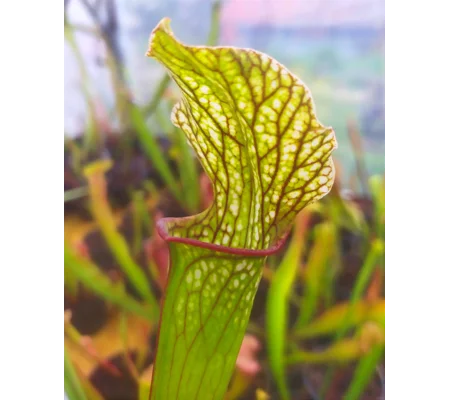
Sarracenia x areolata 'DIVERSIFLORA MESH', Alabama/ Mississippi borderSarracenia x areolata 'DIVERSIFLORA MESH' is natural hybrid, a plant with known location but with open polinated parentage. The plants in our collection are grown from seeds originally collected in the wild on the Alabama - Missisipi border. We acquired them as a mix of seedlings and three of them grew to maturity. S. x areolata is any plant that is hybrid of S. alata and S. leucophylla. It can be found sporadically where the ranges of its parent species overlap, that is on the wet pocosins of the Gulf Coast of North America. A signature of the areolata is that it looks its best in autumn, as it typical for both of its parents too. It's late summer pitchers grow larger than the spring ones and they last until the next growing season. The pitchers are very tall and narrow, but also very stout, the plant produces many of them. You can find cultivation tips on our YouTube channel https://www.youtube.com/@RanchOfPlants
Sarracenia - hybrids
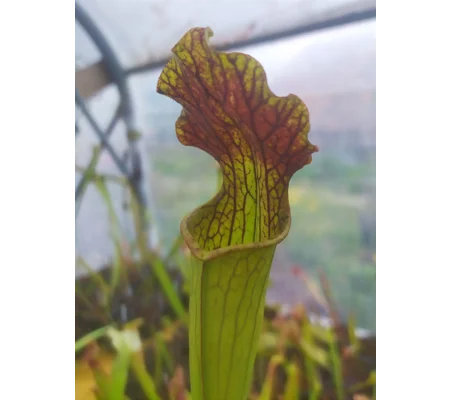
Sarracenia x areolata 'DIVERSIFLORA PEARL', Alabama/Mississippi borderSarracenia x areolata 'DIVERSIFLORA PEARL' is natural hybrid, a plant with known location but with open polinated parentage. The plants in our collection are grown from seeds originally collected in the wild on the Alabama - Missisipi border. We acquired them as a mix of seedlings and three of them grew to maturity. S. x areolata is any plant that is hybrid of S. alata and S. leucophylla. It can be found sporadically where the ranges of its parent species overlap, that is on the wet pocosins of the Gulf Coast of North America. A signature of the areolata is that it looks its best in autumn, as it typical for both of its parents too. It's late summer pitchers grow larger than the spring ones and they last until the next growing season. The pitchers are very tall and narrow, but also very stout, the plant produces many of them. You can find cultivation tips on our YouTube channel https://www.youtube.com/@RanchOfPlants
Sarracenia - hybrids
Sarracenia x areolata 'DIVERSIFLORA RED', Alabama/Mississippi borderSarracenia x areolata 'DIVERSIFLORA RED' is natural hybrid. The plants in our collection are grown from seeds originally collected in the wild on the Alabama - Missisipi border. We acquired them as a mix of seedlings and three of them grew to maturity. This clone is very vigorous and grows taller than both of it's parent species. It's one of the tallest sarras in our collection. S. x areolata is any plant that is hybrid of S. alata and S. leucophylla. It can be found sporadically where the ranges of its parent species overlap, that is on the wet pocosins of the Gulf Coast of North America. A signature of the areolata is that it looks its best in autumn, as it typical for both of its parents too. It's late summer pitchers grow larger than the spring ones and they last until the next growing season. The pitchers are very tall and narrow, but also very stout, the plant produces many of them.You can find cultivation tips on our YouTube channel https://www.youtube.com/@RanchOfPlants
Sarracenia - hybrids
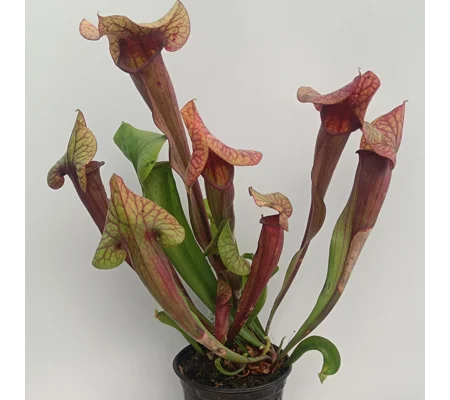
Sarracenia x catesbaei THE GIANTSarracenia x catesbaei 'THE GIANT' is something special, because it is huge. Tall, yes, but look at the size of that pitcher mouth and lid! It's are the size of my hand! I'm guessing this a triploid, because it is HUGE and does not ever flower. Visitors to our greenhouse usually just go pass the ''normal size'' THE GIANT plants in the shop. But when they're confronted with the mother plant in the CP collection they almost always take one home. I still don't know are they intimidated or awstruck by the momma? In any case, this catesbaei is also fully frost hardy. You can find cultivation tips on our YouTube channel https://www.youtube.com/@RanchOfPlants
Sarracenia - hybrids
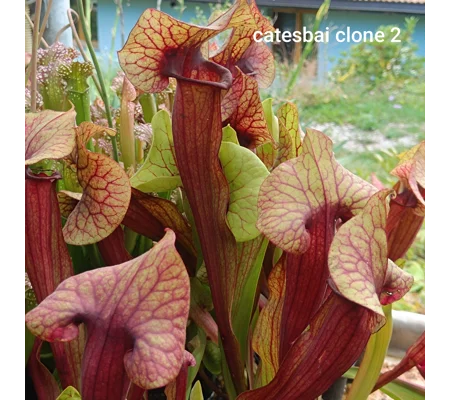
Sarracenia x catesbaei, clone 2Sarracenia x catesbaei clone 2 is a beautiful and vigorous plant. Pitchers are maroon red and golden yellow and color up best in strong direct light. Pitchers are stocky and about 50 cm tall.Catesbaei is a naturally occuring hybrid between S. purpurea and S. flava. In the wild it can be seen where the ranges of the parent species overlap, from Virginia to Florida. It grows in sandy bogs, wet seeps and pocosins (savanna type vegetation of US Gulf Coast). It is vigorous, fast growing and tends to form large colonies, but is not clumpy like S. rubra.
Sarracenia - hybrids
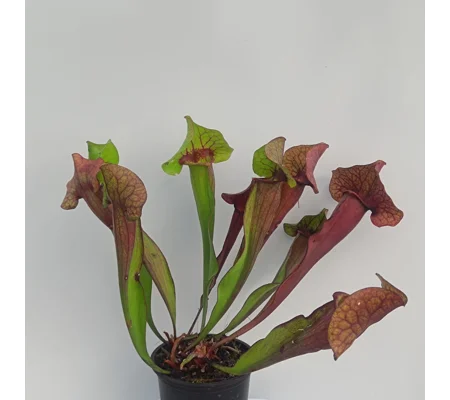
Sarracenia x catesbaei, pink flower, clone 3Sarracenia x catesbaei Pink Flower, clone 3, is a typical-sized catesbaei. It's purpurea parent is S. purpurea subsp. venosa var. burkii (syn. S. rosea). Pitchers color up a nice dark maroon over the summer. Catesbaei is a naturally occuring hybrid between S. purpurea and S. flava. In the wild it can be seen where the ranges of the parent species overlap, from Virginia to Florida. It grows in sandy bogs, wet seeps and pocosins (savanna type vegetation of US Gulf Coast). It is vigorous, fast growing and tends to form large colonies, but is not clumpy like S. rubra. You can find cultivation tips on our YouTube channel https://www.youtube.com/@RanchOfPlants
Sarracenia - hybrids
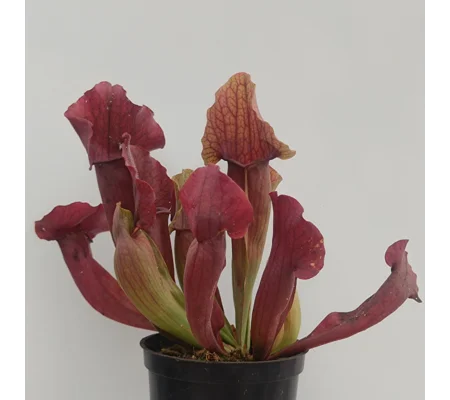
Sarracenia x chelsonii 'MAROON'Sarracenia x chelsonii MAROON is a classic. The compact, clumpy, ruffled-lidded and dark red in all seasons (even in winter) is a wonderful sight. Flowers are dark red and gently sweet scented. The S. rubra is a clumpy plant and gives the habit of producing loads of growing points (side shoots). S. purpurea parent lends its short, stocky shape. Both are responsible for the wonderful deep red coloration. The pitchers start out green, and turn dark red as they mature. S. x chelsonii is the name given to any hybrid of S. purpurea and S. rubra. It is a naturally occuring hybrid, and can be found in in habitats inhabited by both parent species. It's found in wet pocosins of coastal Southeastern United States. We offer plants in L size. You can find cultivation tips on our YouTube channel https://www.youtube.com/@RanchOfPlants