
All Products
Sarracenia - species
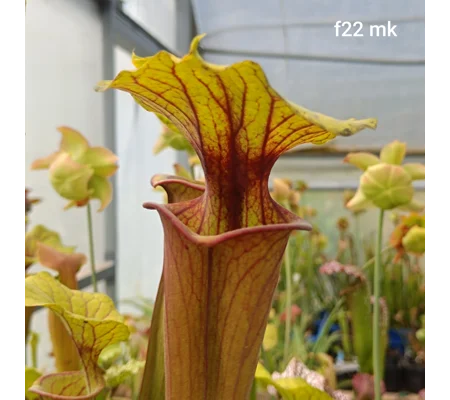
Sarracenia flava var. rubricorpora F22MK, Appalachicola NF, Fl.Sarracenia flava var. rubricorpora F22MK, Appalachicola National Forest, Florida. This clone is is characterized by a massive, very regularly shaped mouth. The interior of the pitcher and the lip remain bright yellow and contrast well with the red surface of the pitcher exterior. The lid has strong red ornata style veining and a rugelii style throat patch. This clone is a giant that towers above other flavas. It is also a strong grower and forms clumps quickly. We stock a few M size plants, they will flower in 2 years, but expect nearly adult size pitchers in the coming season.You receive an adult plant.You can find cultivation tips on our YouTube channel https://www.youtube.com/@RanchOfPlants
Sarracenia - species
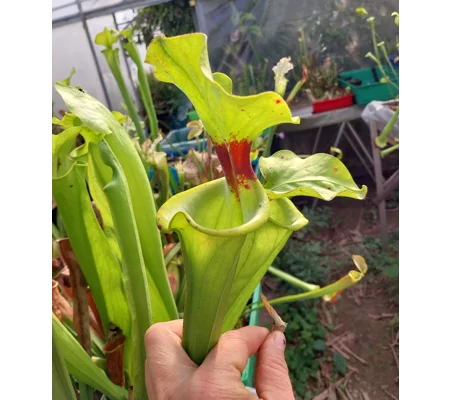
Sarracenia flava var. rugelii F120B MSSarracenia flava var. rugelii F24A MS is an outstanding plant. Good size pitchers, bright green with a large red throat patch. Sarracenia flava is distributed from southern Alabama, through Florida and Georgia, to the coastal plains of southern Virginia, North and South Carolina. The species has 7 varieties, based on presence and distribution of red color. Some varieties are more common in some areas, others in other, but they all overlap. You can find cultivation tips on our YouTube channel https://www.youtube.com/@RanchOfPlants
Sarracenia - species
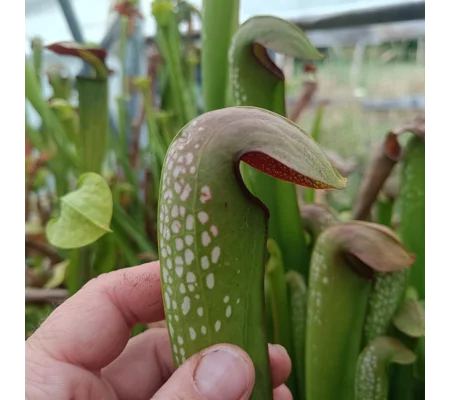
Sarracenia minor var. okefenokeensis, Ware co., GeorgiaSarracenia minor var. okefenokeensis, Ware Co, Georgia grows impressively tall. At more than 90 cm this particular clone towers over the typical form of the species. Okefenokensis variety is primarily found in the Okefenokee National Wildlife Refuge. The plants were originally registered by Peter D Amato under the name Okee Giant before being formally described as S. minor var. okefenokeensis by Dr. Don Schnell. Medium size plants with one growing point. The typical form of minor is up to 30 cm tall, thus the name minor = small. Sarracenia minor s. lato. inhabits swamps of northen Florida, Georgia and North and South Carolina. Its populations around Lake Okeechobee are the Southernmost of any Sarracenia.You receive an adult plant.You can find cultivation tips on our YouTube channel https://www.youtube.com/@RanchOfPlants
Sarracenia - species
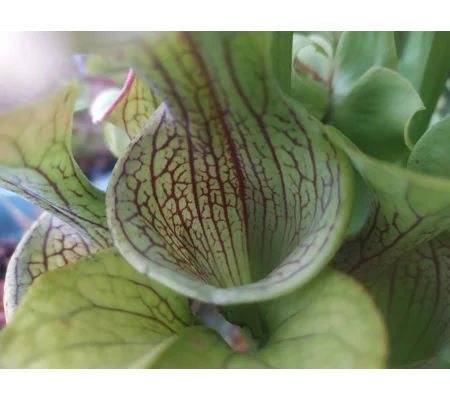
Sarracenia oreophylla var. ornata, de Kalb co., Alabama, R-S8aSarracenia oreophylla var. ornata, de Kalb co., Alabama, R-S8a has nice red-veined pitchers. Sarracenia oreophylla is a unique plant. It sprints thru the growing season: simultaneously flowers and pitchers early in the spring growing season. This means that it eats its pollinators, and is one of the very few carnivorous plants doing so. By about mid-summer, it already goes into phyllodia production. Phyllodia are a secondary type of flat leaf-like organ that allows the plant to photosynthesize. Phyllodia are characteristically small and sicle-shaped. For oreophylla this is an adaptation to naturally drier summer months in its native habitat. Basically it eats its flying insects in spring and goes vegan by late summer. The pictures you see in the gallery are all from one plant, from different seasons. You can see how strikingly different the plant looks during winter and late spring.You can find cultivation tips on our YouTube channel https://www.youtube.com/@RanchOfPlants
Sarracenia - species
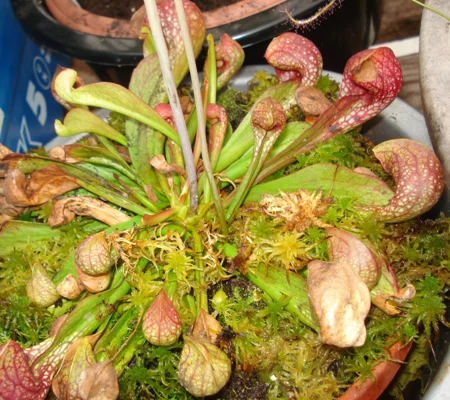
Sarracenia psittacina subsp. psittacinaThe psittacina - the parrot pitcher plant. The only Sarracenia whose pitchers grow horizontally. The bulbous hood of the pitchers has only one round entrance, that looks and works like a mouse trap: insects are lured in, but they can't find the way out. It catches ants, I also found a small slug in there. Generally psittacina is not such a voracious hunter and grows slow. You can find cultivation tips on our YouTube channel https://www.youtube.com/@RanchOfPlants
Sarracenia - species
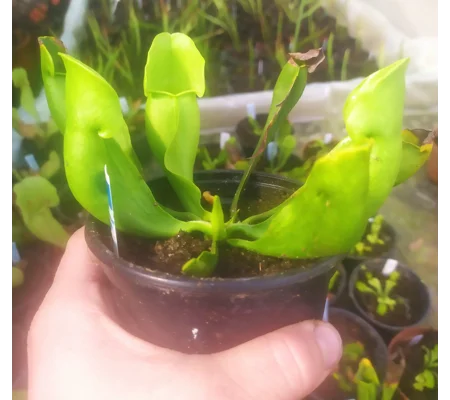
Sarracenia purpurea subsp. purpurea f. heterophyllaSarracenia purpurea subsp. purpurea f. heterophylla is a rare antho-free version of the hardiest Sarracenia. It can survive winters to -50C and is therefore best grown as an outdoor plant. Its range includes the Eastern seaboard, the Great Lakes region, Canada except Nunavut and Yukon, Washington state, and Alaska. That makes it the most common and broadly distributed pitcher plant, as well as the only member of the genus that inhabits cold temperate climates.You can find cultivation tips on our YouTube channel https://www.youtube.com/@RanchOfPlants
Sarracenia - species
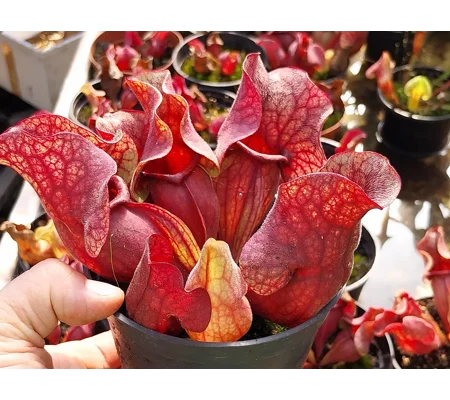
Sarracenia purpurea subsp. venosaSarracenia purpurea subsp. venosa is a winterhardy plant. It can survive winters below -20C and is therefore best grown as an outdoor plant. But it won't mind being grown as a house plant. Try to give it a cool winter rest, if possible. Sarracenia purpurea is distributed on the Eastern seaboard, the Great Lakes region, Canada except Nunavut and Yukon, Washington state, and Alaska. That makes it the most common and broadly distributed pitcher plant, as well as the only member of the genus that inhabits cold temperate climates. It is endangered or vulnerable over much of the southern part of its range. Many venosa populations are extinct in the wild and only exist location plants in collections.You can find cultivation tips on our YouTube channel https://www.youtube.com/@RanchOfPlants