
 Slovenščina

New Products

Product Details

Utricularia dichotoma subsp. novae-zelandiae
Product Code:UtrNov
Product Condition:New
8,00 € inc. tax
Description
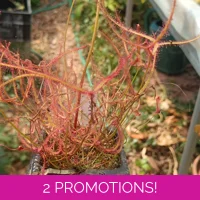
Utricularia dichotoma subsp. novae-zelandiae commonly known as fairy aprons, is a variable, perennial species of terrestrial bladderwort. It grows in moist and wet locations.
It has numerous underground trailing stems with bladders 1.5–2 mm (0.06–0.08 in) in diameter. It has absent or a few oval, spoon-shaped to narrow-lanceolate leaves 2–4 mm (0.08–0.16 in) long and up to 40 mm (1.6 in) long. The former is more typical of plants growing in wet soil, the latter of plants growing fully submerged. The flowers are borne on a slender, wiry stem 5–50 cm (2.0–19.7 in) long; they are solitary, paired or in whorls of three or four in clusters near the end of the stem. They are mauve or purple and have a small upper petal and a broader, semicircular lower lip 1–2 cm (0.4–0.8 in) wide with two or three prominent white or yellow markings, and the corolla is 12–22 mm (0.5–0.9 in) long. Flowering occurs from August to April and the fruit is a globular capsule up to 4 mm (0.16 in) wide.
Utricularia dichotoma subsp. novae-zelandiae is a native a widespread species. Its one of 8 subspecies who are distributed from New Caledonia, New Zealand to Australia. Utricularia dichotoma subsp. novae-zelandiae occurs on the North and South Islands in New Zealand, as well as Stewart Island / Rakiura, the most southerly location at which a member of this genus occurs.
Utricularia dichotoma was first formally described in 1805 by Jacques Labillardière and the description was published in Novae Hollandiae Plantarum Specimen. The specific epithet (dichotoma) is Latin for "dividing into pairs" and refers to the double arrangement of flowers which this species often displays. Utricularia dichotoma subsp. novae-zelandiae (Hook.f.) R.W.Jobson is one of the 8 currently recognized subspecies.
You can find cultivation tips and more on our YouTube channel
https://www.youtube.com/@RanchOfPlants
Reviews
No Reviews Posted Yet - be the first!
write review
Promotion Offer!
Spend €60.00 or over and get 5% off all products
Spend 60,00 € and save 5.0% off your order
Promotion Offer!
Spend €120.00 or over and get 10% off all products
Spend 120,00 € and save 10.0% off your order

Utricularia sandersonii..
6,00 €

Utricularia parthenopipes
7,00 €

Utricularia uniflora L-..
8,00 €
Utricularia warburgii
8,00 €

Utricularia dichotoma s..
8,00 €